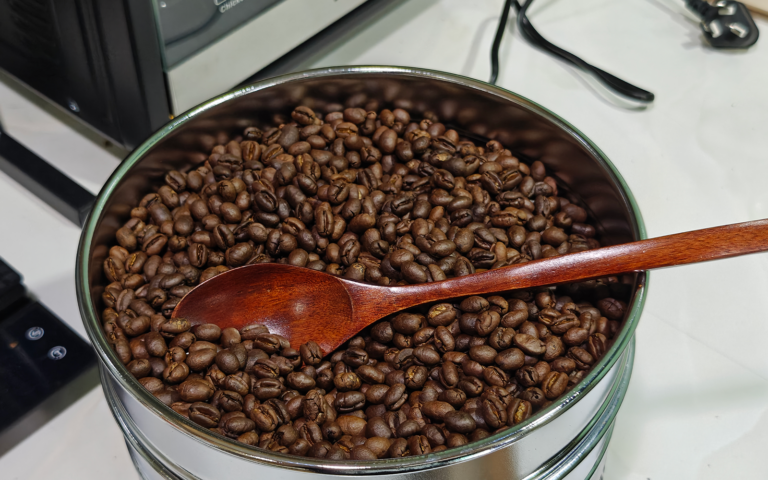
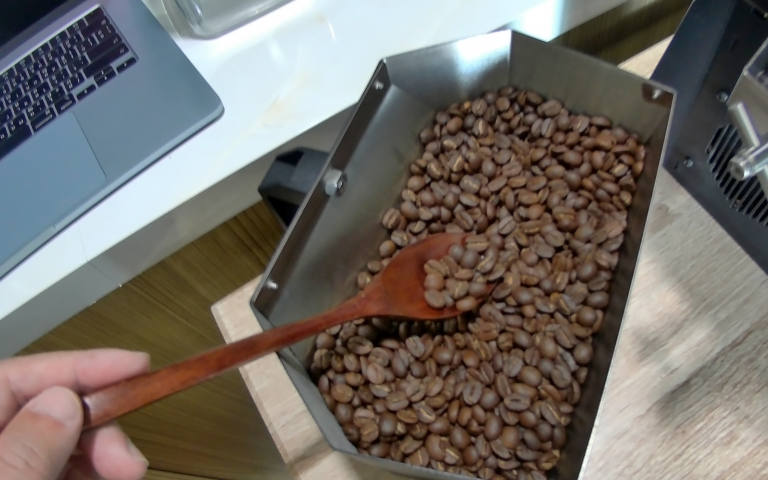
After struggling through two frustrating Robusta roasts where every assumption failed and my Arabica-trained instincts led me astray, I needed a reset. Enter: Brazilian beans from my October 2025 roasting course—familiar ground where I could rebuild confidence and recalibrate my understanding of the Kaleido M6’s temperature personality.
The Advantage of Prior Experience
This wasn’t a completely new bean. During my roasting course last October, I’d worked with this same Brazilian lot, learned its behavior, understood its flavor potential. That familiarity gave me something I’d been lacking with Robusta: expectations based on actual experience with this specific coffee.
I knew roughly how this bean should respond to heat. I’d seen its color progression before. I’d tasted the results of good roasts and mediocre ones during the course.
Coming back to it nine months later on my own roaster felt like returning to a trusted friend after chaotic encounters with unpredictable strangers.
The Roast: Smooth Execution
For the first time in weeks, a roast went smoothly.
No panic. No scrambling. No “wait, why isn’t this behaving like I expected?” moments. Just steady heat application, predictable phase transitions, and controlled progression from green to developed coffee.
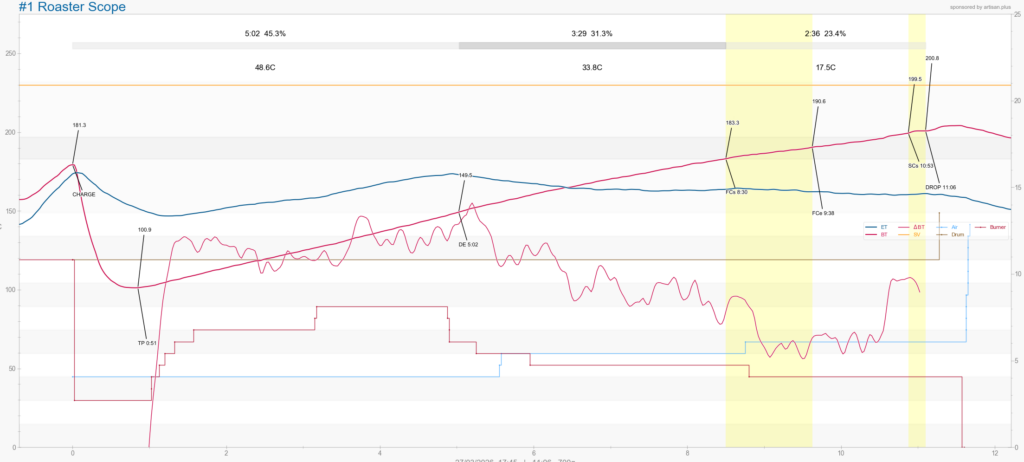
Recorded Bean Temperatures:
- Dry End (DE): 149.5°C
- First Crack (FC): 183.3°C
- Second Crack (SC): 199.5°C
I actually heard first crack—clearly, unmistakably. The familiar Arabica pop-pop-pop that Robusta had denied me. Visual cues aligned with audio feedback. Temperature rise matched expectations.
Everything worked the way roasting is supposed to work when you understand the bean and the bean cooperates.
The Kaleido Temperature Offset Discovery
Here’s what caught my attention: These temperatures run 10-15°C lower than what I learned during the course last year.
During training, we were using different roasters (not Kaleido M6s). The same Brazilian bean on that equipment showed:
- DE around 160-165°C
- FC around 195-200°C
- SC around 210-215°C
On the Kaleido M6:
- DE at 149.5°C
- FC at 183.3°C
- SC at 199.5°C
The delta: roughly 10-15°C across all phases.
This isn’t the bean behaving differently—it’s sensor calibration and placement differences between roasting machines. The Kaleido’s bean temperature probe is positioned and calibrated in a way that reads consistently 10-15°C lower than the equipment I trained on.

Why This Matters: Absolute vs Relative Temperature
This discovery is liberating: Absolute temperature numbers don’t matter. Relative relationships do.
It doesn’t matter that my FC happens at 183°C while someone else’s happens at 196°C on different equipment. What matters is:
- The gap between DE and FC (for me: 183.3 – 149.5 = 33.8°C)
- The gap between FC and SC (for me: 199.5 – 183.3 = 16.2°C)
- Rate of rise patterns through each phase
- Time spent in each phase relative to total roast time
Once I internalize the Kaleido M6’s temperature offset, I can stop comparing my numbers to others’ and focus on building my own reference framework. My 183°C FC is their 196°C FC—same physical phenomenon, different sensor reading.
This explains why I initially struggled with beans like Mae Salong and Khun Kong. I was chasing temperature targets from research and training that didn’t account for my specific machine’s calibration. No wonder my roasts felt chaotic—I was aiming at numbers that didn’t match my reality.

The First Roast Result: Nice and Accurate
The roast itself? Nice.
Not “amazing” or “perfect”—but clean, controlled, and properly developed. No overshooting into dark roast. No underdevelopment. Just a well-executed roast that landed where I intended.
More importantly, I captured accurate BT data that I can trust:
- DE at 149.5°C
- FC at 183.3°C
- SC at 199.5°C
These aren’t theoretical numbers or borrowed from online forums—they’re my Kaleido M6’s actual behavior with this specific Brazilian bean. That data is gold for planning future roasts.
Why This Roast Felt Different
After the Robusta chaos and even some of my struggling Catuai attempts, this Brazilian roast reminded me of something important:
Competence feels good.
When you understand the bean, when the machine behaves predictably, when audio and visual cues align, when your plan matches the outcome—roasting is satisfying. It’s creative problem-solving with immediate sensory feedback.
This Brazilian bean becomes a reference point in my growing Kaleido M6 temperature library:
What’s Next
With accurate Brazil BT data in hand, the next roast will focus on flavor profiling: adjusting Maillard time and development to bring out specific characteristics—sweetness, body, acidity balance.
But for now, I’m just appreciating a roast that went well. After Robusta humbled me, Brazil reminded me why I started this journey: the satisfaction of understanding, controlling, and improving.
Sometimes you need to revisit familiar territory to remember you’re capable of navigating it.
Roast Status: Success – smooth and accurate
Key Discovery: Kaleido runs 10-15°C lower than training equipment
BT Data Captured: DE 149.5°C, FC 183.3°C, SC 199.5°C
Confidence Level: Restored
Next Action: Flavor-focused profile refinement on second roast
Roast Profile:
- Bean: Brazil (from October 2025 course)
- DE: 149.5°C
- FC: 183.3°C
- SC: 199.5°C
- Result: Clean, well-developed, on-target roast
- Lesson: Machine calibration matters more than absolute numbers