Introduction
Every roaster’s journey begins with that first crack of uncertainty—literally and figuratively. Today marks my inaugural roast with the Kaleido M6, using Mae Salong beans from Chiang Rai, Thailand. While the results weren’t perfect, the lessons learned were invaluable.
The Bean
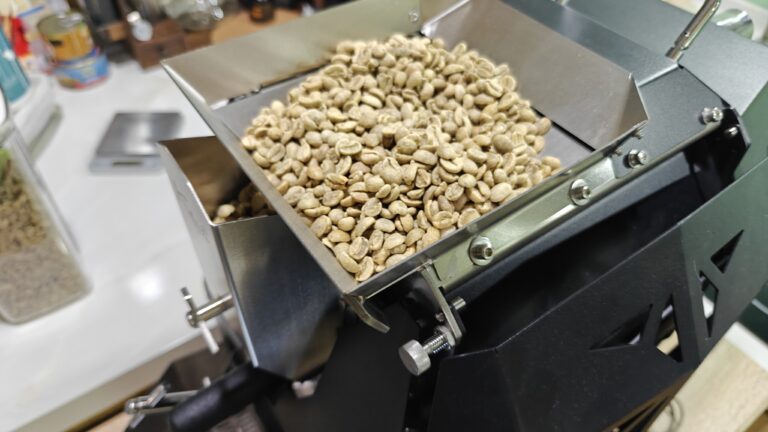
Mae Salong is a wet-processed coffee known for its promising flavor profile: bright citrus or cherry notes balanced with cocoa or dark chocolate undertones, finished with brown sugar or sugarcane sweetness. The beans came in with 10% moisture content and 0.73 density—solid numbers that suggested good potential.

The Roast: Trial by Fire
Here’s where things got interesting. Unfamiliar with the Kaleido M6, I set the drum speed at 50 RPM. Big mistake. The ideal setting should have been 80 RPM, and this seemingly small error cascaded into multiple challenges throughout the roast.

The slow drum speed created two immediate problems. First, I struggled to pull samples from the bean trier to monitor color development—the beans simply weren’t moving efficiently enough through the drum. Second, and more critically, the heat distribution became uneven. When beans don’t tumble properly, they receive inconsistent heat application, throwing off temperature readings and making it nearly impossible to track the roast accurately.

The Numbers
Despite these challenges, I pushed forward and recorded my milestones:
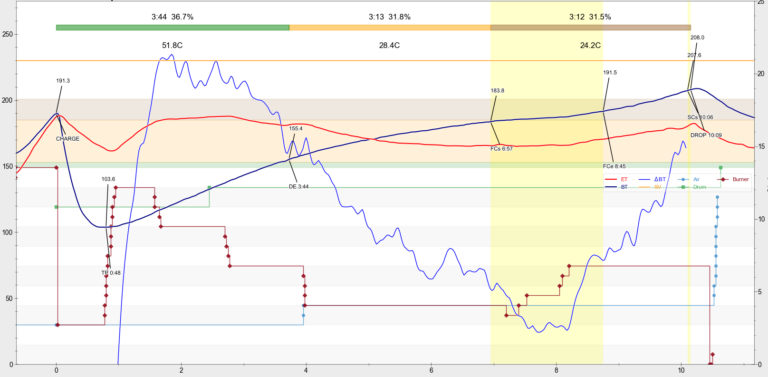
These temperatures are outside the typical ranges I’ve studied. The question now: Is this a quirk of the Kaleido M6’s temperature sensor calibration, or simply the consequence of improper drum speed affecting heat transfer and measurement?
Artisan Profile

Referring to the profile, the temperature appears too low for both FC and SC. I need to investigate further to understand whether the temperature sensor is functioning correctly or if the drum speed is too slow.