
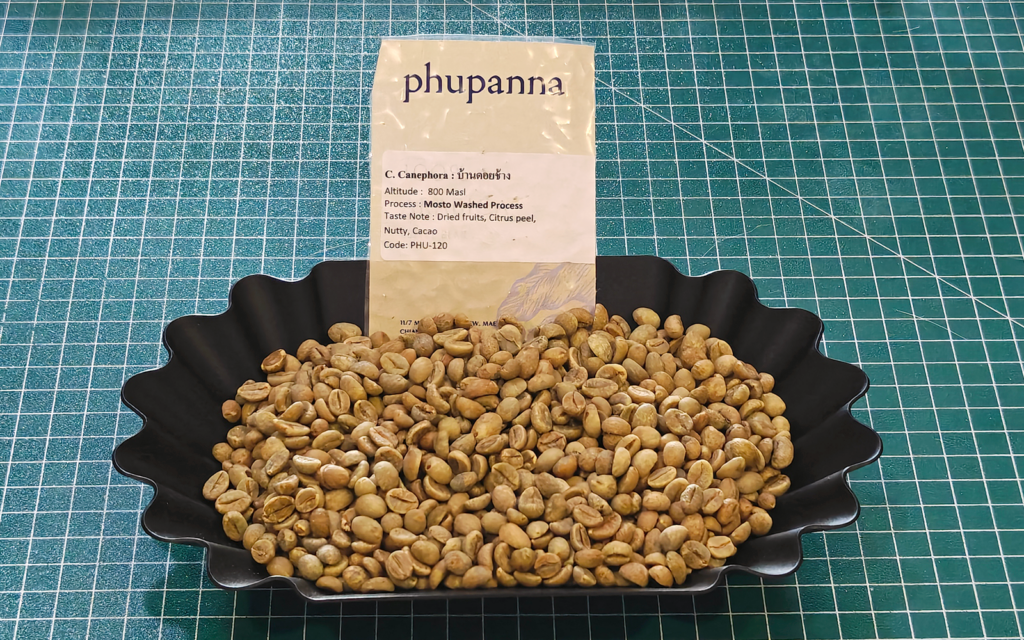
After focusing exclusively on Arabica beans, I’m stepping into new territory: Robusta. This C.Canephora lot from Chiang Mai represents a departure from my usual roasting profile—and an opportunity to explore Thailand’s coffee diversity beyond high-altitude Arabica.
The Bean Profile
Species: C.Canephora (Robusta)
Origin: Chiang Mai, Thailand
Process: Mosto Washed
Moisture Content: 10.6%
Density: 0.72
Batch Size: 1kg
Why Robusta?
Robusta gets a bad reputation in specialty coffee circles—often dismissed as bitter, harsh, and lacking the nuanced complexity of Arabica. But that narrative is changing. Quality Robusta, when grown at altitude and processed carefully, can offer unique characteristics that Arabica simply doesn’t provide.
This particular lot caught my attention for two reasons: the origin (Chiang Mai’s increasingly sophisticated coffee production) and the processing method.
Mosto Washed Processing
“Mosto” refers to the mucilage or fruit juice surrounding the coffee bean. Mosto washed processing is a hybrid method that ferments beans in their own fruit mucilage before washing, creating a middle ground between fully washed and natural processing.
This method can add fruit-forward sweetness and complexity while maintaining the clean cup profile associated with washed coffees. For Robusta—which naturally carries more body and bitterness than Arabica—this processing could theoretically add dimension and balance.
Expected Characteristics
According to the supplier notes:
Flavor Profile:
- Dried fruits
- Citrus peel
Cup Character:
- Full body
- Low acidity
This profile aligns with Robusta’s natural strengths. The species typically delivers:
- Heavy body: That thick, syrupy mouthfeel Arabica rarely achieves
- Low acidity: Robusta lacks the bright, citrusy tartness of high-altitude Arabica
- Earthy, woody notes: Often with chocolate or nutty undertones
- Higher caffeine: Roughly double Arabica’s caffeine content
The “dried fruits” and “citrus peel” notes suggest this lot has more going on than typical commercial Robusta’s flat bitterness—the mosto processing likely contributing fruit complexity.
The Density Question
At 0.72 density, this Robusta sits slightly lower than my Arabica beans (typically 0.73). Lower density generally means:
- Faster heat absorption
- Quicker progression through roast phases
- Potential for uneven development if not carefully controlled
The 10.6% moisture content is slightly higher than my Arabicas, which could affect drying phase timing. These physical differences mean I can’t simply apply my Arabica roast profiles—Robusta demands its own approach.
The Plan: Medium-Dark Roast
With only 1kg to experiment with, I’m targeting medium-dark roast for this Robusta. Here’s why:
Bitterness Management: Robusta naturally contains more chlorogenic acids than Arabica, contributing to perceived bitterness. Pushing into medium-dark territory (into or just past second crack) can actually mellow some of that harsh edge through further caramelization.
Body Maximization: Robusta’s strength is body. A medium-dark roast will emphasize that full, heavy mouthfeel while developing chocolate and roasted nut characteristics.
Blending Insurance: If the straight Robusta proves too bitter or one-dimensional for my palate, a medium-dark roast level makes it ideal for blending with Arabica. A 20-30% Robusta addition can add body, crema (for espresso), and depth to brighter Arabica beans without overwhelming their origin character.
The Blending Strategy
Many espresso blends incorporate Robusta for specific reasons:
- Crema production: Robusta creates thick, stable crema that Arabica struggles to match
- Body enhancement: Adds weight and texture to lighter Arabicas
- Cost efficiency: Robusta is typically less expensive than specialty Arabica
- Caffeine boost: Higher caffeine content for those who want it
If this C.Canephora roasts well, I’m curious to blend it with my Mae Salong or Mae Ukho Arabicas—creating a Thai-only blend that showcases different altitudes, processing methods, and species from the same region.
The contrast could be fascinating: Mae Ukho’s bright, sweet acidity balanced by Robusta’s heavy body and low acidity. Two expressions of Chiang Mai terroir in one cup.
What’s Next
First, I need to establish baseline data for how this Robusta behaves in the Kaleido M6:
- Where does dry end occur?
- When does first crack arrive?
- How quickly does it progress to second crack?
- What does medium-dark actually look, smell, and taste like with this bean?
Then comes the brewing tests—straight Robusta versus blended ratios with Arabica.
This is uncharted territory for me. Every bean I’ve roasted so far has been Arabica. Robusta’s different density, moisture content, cellular structure, and chemical composition mean I’m essentially learning to roast again from scratch.
But that’s the point of this journey: understanding coffee in all its diversity, not just the comfortable specialty Arabica lane.
Let’s see what Robusta can do.
Bean: C.Canephora Robusta, Chiang Mai
Process: Mosto Washed
Target: Medium-dark roast
Backup Plan: Arabica blending component
Next: First roast for baseline data


